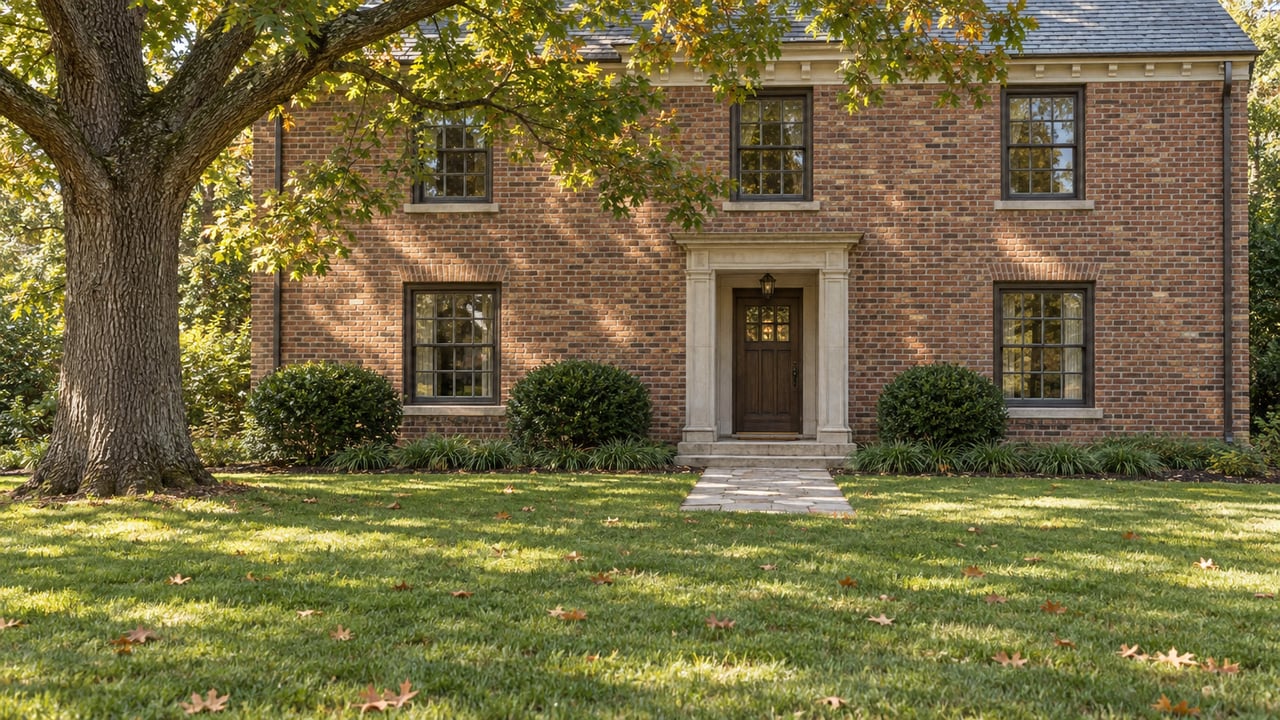
According to The Real Deal, Shiraz and Vijay Kotte bought the Clement Stone Mansion at 445 Sheridan Road in 2023 for $12.3 million. The Spanish Revival estate had stood since 1912, built for socialite and real estate investor Lena P. Gilmore, later home to hotel magnate Albert Pick, restored once in 2006 to preserve its white stucco walls and red clay tile roof. By January 2025 the Kottes had a demolition permit. By August 2025 the lot sat empty. Their replacement home, approved in June, will run nearly 29,000 square feet and cost an estimated $10 million to build, according to the permit application.
Nobody bought that century-old mansion because they wanted a century-old mansion. They bought a lakefront parcel that happened to have one sitting on it, and the structure was worth less to them than the cost of removing it.
That transaction is not an outlier in Winnetka. It is close to the operating logic of the market at the moment, and it explains something that trips up anyone comparing Winnetka's numbers to another North Shore town: the median price and the price-per-square-foot figure everyone quotes are not describing one product. They are averaging two.
Two Numbers, Two Products
Pull Winnetka's price-per-square-foot from two different sources this year and they will not agree. Redfin put the median sale price per square foot at $549 as of March 2026, up 8.7 percent year over year, on a median sale price of $1.7 million. Movoto's figure for the same market, drawn from June 2026 listings, was $479 per square foot on a median list price of $2.24 million.
Part of the gap is methodology. Redfin's number tracks closed sales; Movoto's tracks what's currently listed. But methodology alone doesn't explain a $70 difference in a market this size. The deeper issue is that both numbers are blending sales of finished, move-in-ready homes with sales of properties where the buyer's actual intent was the dirt underneath. A renovated Georgian that closes at $549 a foot and a lot that closes at $200 a foot because the buyer is paying demolition costs on top produce a median that describes neither.
This is why a Winnetka comparison against, say, Glencoe or Deerfield can mislead a buyer who takes the headline number at face value. The question isn't just what does the median dollar buy in each town. It's whether that median dollar, in Winnetka specifically, is buying a house at all.
Why Land Became the Product
Dena Fox, an agent with the Rubenstein Fox Team at Baird & Warner, put it plainly to The Real Deal: it's extremely hard to find land to build on in this market. That scarcity is the mechanism. When there is effectively no vacant lakefront inventory, the only way to acquire lakefront land is to buy an existing home and treat the structure as a cost center rather than an asset.
The clearest illustration is private equity executive Justin Ishbia's compound on Sheridan Road. Ishbia paid $33.7 million assembling three adjacent lakefront properties, then budgeted $43.7 million to build a 68,000-square-foot home on the combined site, a total north of $77 million before a single finished room existed. At that scale, the distinction between land value and structure value effectively disappears. The existing houses on those three parcels were not amenities. They were obstacles cleared to unlock the assemblage.
The two most expensive homes ever sold in Illinois both closed in Winnetka last year at more than $30 million apiece. Numbers like that don't function as a ceiling on the local market so much as a signal of what the land under specific parcels is now worth to a buyer willing to demolish and rebuild.
The Bluff Ordinance and Land Use
In 2024, Winnetka passed an ordinance restricting new construction on or near the bluffs along Lake Michigan. Village officials and press coverage connected the rule with Ishbia's compound plans.
A group of homeowners, including the LLC that owned the Kottes' property, sued the village, arguing the ordinance had cut millions of dollars from their property values. That is not a complaint about home values in the conventional sense. It is a complaint about land-use rights, the ability to build to a certain envelope on a certain lot. Vijay Kotte, CEO of Chicago-based GoHealth, told village officials in 2024 that he would have reconsidered the purchase price of the mansion had he known the bluff restriction was coming.
The Kottes dropped out of the litigation in December, months after their own project won approval. Whether that sequencing was coincidence or leverage isn't something the public record settles, but the timeline is on file with the village. For any buyer looking at bluff-adjacent property in Winnetka now, the ordinance is a fixed constraint on what a given lot can become, and that constraint is priced into land value the same way lot size or frontage is.
The Same Logic, Moving Inland
The pattern isn't confined to the shoreline. A builder tied to Michael Klein, operating as Michael Bennett Homes within the Airoom Companies portfolio, bought a vacant one-acre lot on Sunset Road in July 2024 for roughly $2 million. That parcel has no lake frontage at all. As of an April 2026 Hoodline report, the same lot is listed at $16.9 million for a home that doesn't exist yet, a planned 17,000-plus-square-foot spec house with an art gallery and a wellness center, targeting 2027 completion. Agent Mary Maris is handling the listing through Village Realty Group and Corcoran Urban Real Estate.
If that number holds, it would top recent sales for off-lake property in Winnetka. The bet embedded in that price is that buyers priced out of true lakefront will pay lakefront-adjacent money for scale and finish on land that was, two years earlier, valued at a small fraction of the asking price. Whether or not this specific listing closes anywhere near $16.9 million, the fact that a builder is willing to carry a $2 million lot for three years on that assumption says something about where land-value expectations in Winnetka currently sit, independent of what gets built on top.
What This Means If You're Comparing Numbers
Anyone using Winnetka's median price or price-per-square-foot to size up the town against a neighboring community should ask a more specific question first: is this figure describing a finished home, or is it describing a lot that happens to have a building on it right now.
Geography inside Winnetka matters here too. Listings and market commentary consistently note that homes east of Green Bay Road carry a premium tied to lake proximity, while desirable inventory exists west of it at different price logic entirely. A teardown candidate east of Green Bay Road and a move-in-ready renovation west of it can list at similar dollar figures for entirely different reasons, one priced on land potential, the other priced on the finished square footage a buyer gets to use immediately.
For a buyer, the practical takeaway is to ask what's actually being purchased before comparing dollar figures across towns or across listings within Winnetka itself. For a seller holding an older or unrenovated home, particularly one on a larger lot or closer to the water, the Kotte and Ishbia transactions suggest the land underneath may be worth pursuing as its own conversation, separate from what a renovation would add to the structure.
A Few Questions Worth Asking Directly
Does this land-value dynamic only apply to lakefront property? No. The Sunset Road listing has no lake frontage and is still being priced on land-and-scale logic rather than on the value of an existing structure, since none exists yet.
How can a buyer tell whether a listing is priced as a house or as a lot? Days on market, price per square foot relative to comparable finished homes nearby, and whether the listing language emphasizes lot dimensions and buildable envelope over interior finishes are all indicators worth checking against recent permit activity for the immediate area.
Does the 2024 bluff ordinance affect homes that aren't near the water? The rule specifically targets construction on or near the bluffs along Lake Michigan, so its direct effect is limited to that corridor, though it set a precedent for how the village may approach large assemblages elsewhere.
If you're weighing a Winnetka property against another North Shore option and want a read on whether you're pricing a home or pricing the land under it, Nicole Fabiano can walk through the comparison with you before you make an offer.
This article is general information, not legal, tax or financial advice. Consult a qualified professional about your situation.